
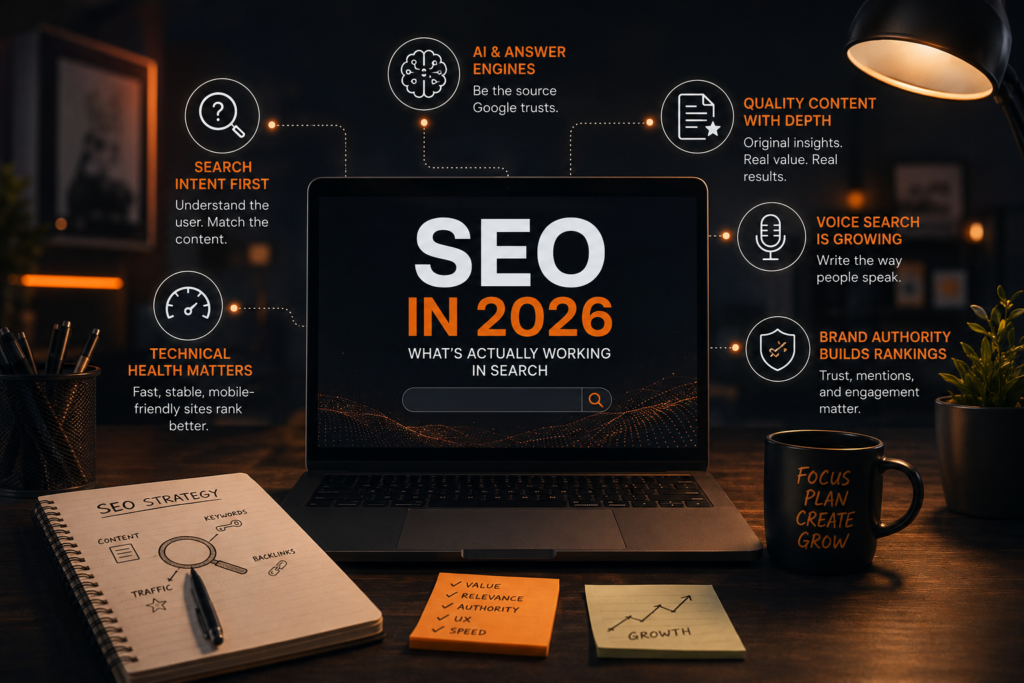
SEO in 2026: What I’m Seeing Actually Work in Search
Every year, someone declares that SEO is dead. I’ve been hearing it for years, and yet businesses continue to grow through search. What has actually died is the outdated way of doing SEO. The shortcuts, keyword stuffing, mass-produced content, and manipulative backlink strategies that once worked are rapidly losing their value.
Over the last 16 years, my journey has evolved from branding, graphic design, and visual communication into website design, SEO, AI-powered content creation, digital marketing, and modern creative strategy. Studying these fields together has changed the way I look at search. One thing has become increasingly obvious: Google is no longer rewarding websites that simply produce content. It rewards businesses that genuinely help people.
I’ve worked with businesses that consistently publish blogs, chase high-volume keywords, and invest in backlink campaigns, yet still struggle to improve their rankings. The problem isn’t SEO. The problem is that many businesses are still applying strategies built for Google’s algorithm from five or ten years ago. Search has evolved, and successful SEO requires a completely different mindset.
The biggest shift I’m seeing is that Google is becoming an answer engine rather than just a search engine. With AI Overviews, Featured Snippets, and People Also Ask, users often receive answers before they even visit a website. That doesn’t reduce the importance of content—it raises the standard. Instead of creating articles filled with repeated keywords, I focus on answering real questions, organizing information clearly, and making content easy for both users and search engines to understand. The goal is no longer to publish more content. The goal is to become a trusted source.
AI has accelerated this change even further. Today, anyone can generate an article in minutes, and that’s exactly why so much online content feels identical. AI is an incredible productivity tool, but it cannot replace experience. I use AI every day to improve my workflow, generate ideas, and speed up production, but I never allow it to replace practical knowledge or original thinking. Your experience, observations, successes, failures, and real-world insights are what give content lasting value. AI can help create content, but only human expertise makes it worth reading.
Another mistake I still see is businesses obsessing over search volume instead of understanding search intent. Many SEO discussions begin with the question, “Which keyword should we target?” I prefer asking, “What is the person actually trying to achieve?” Someone searching for the best logo designer has a completely different intention from someone searching for affordable branding services or website design pricing. Understanding that difference changes how content should be written. When your page genuinely solves the visitor’s problem, both Google and the user recognize its value.
Technical SEO is another area that businesses often underestimate. I’ve seen beautifully designed websites fail simply because they were slow, unstable, or frustrating to use on mobile devices. Great content alone isn’t enough if the overall experience is poor. Before recommending more blogs or additional pages, I always suggest evaluating website speed, Core Web Vitals, mobile usability, crawl errors, broken links, internal linking, and overall technical performance. In many cases, fixing these issues delivers better results than publishing ten new articles.
Search behaviour is also becoming more conversational. People no longer search the way they did a few years ago. Instead of typing short keyword phrases, they’re asking complete questions through voice search and AI assistants. That shift has changed the way I write. Rather than forcing technical language into every paragraph, I focus on clear, natural communication. Simple language often performs better because it’s closer to how real people think and speak.
Perhaps the biggest change of all is that branding and SEO are no longer separate disciplines. Google isn’t just evaluating websites anymore; it’s evaluating businesses. Brand searches, user engagement, mentions from trusted websites, repeat visitors, positive experiences, and overall reputation all contribute to how search engines measure authority. Strong branding strengthens SEO, and strong SEO reinforces the brand. They now work together as part of one digital ecosystem.
At the same time, several traditional SEO tactics continue to lose relevance. Keyword stuffing makes content difficult to read without improving rankings. Large volumes of low-quality backlinks rarely provide lasting value compared to a handful of relevant, authoritative links. Generic AI-written articles offer little reason for Google to recommend one website over another. And ignoring user experience remains one of the fastest ways to lose both rankings and conversions. Getting visitors to your website is only half the job. Keeping them engaged is what truly matters.
My approach to SEO has always been shaped by my background in branding and design. I don’t see SEO as a separate service or a checklist of technical tasks. I see it as part of a complete digital experience where branding, website design, user experience, content strategy, technical SEO, AI-powered workflows, and digital marketing all work together toward the same goal. When these elements are aligned, businesses don’t just rank higher—they build trust, attract better customers, and create long-term growth.
SEO isn’t becoming easier. It’s becoming smarter. The businesses that will succeed over the next few years won’t necessarily be the ones spending the most money. They’ll be the ones willing to adapt, provide genuine value, and build trust before trying to chase rankings. Algorithms will continue to evolve, AI will become even more powerful, and search will keep changing. But one principle has remained true throughout my career and I believe it will continue to define the future of SEO: useful content, real expertise, and an exceptional user experience will always outperform shortcuts.
Author
Rinesh K
Creative Strategist | Branding | SEO | AI-Powered Digital Marketing | Website Design | Visual Communication